Understanding the Role of the Logit Model in Decision Making: The Uber vs. Lyft Choice Problem
When people make choices, they don’t always act in a purely rational way. Sometimes, they consider price and time, while other times, brand loyalty, convenience, or mood might influence their decisions. The scale parameter (μ) helps capture this randomness in choice models like the logit model. In this post, we’ll break down a simple ride-sharing decision and explore how μ impacts the probability of choosing Uber or Lyft.
The consumer buys when the utility of buying exceeds the utility of not buying.
Disclaimer : This post is for learning and data is not real. And not reflect the service quality as well
Step 1: Defining the Utility Function
To model a customer’s decision, we assume their choice depends on several factors like price, wait time, driver rating, and personal preference. The utility function (a numerical representation of how much a customer values each option) can be written as:
Where:
are weights representing how much each factor contributes to the decision.
A higher U value means a higher preference for that option.
The scale parameter (μ) determines how deterministic or random the choice is.
Step 2: Assigning Values to Uber and Lyft
Let’s assume a customer is choosing between Uber and Lyft with the following attributes:
Attribute
Uber
Lyft
Weight (β)
Price (Rs.)
300
320
-0.02
Wait Time (min)
5
8
-0.5
Driver Rating
4.8
4.6
+2.0
Brand Preference
1
0
+1.5
Now, we compute the utility for each ride-sharing option.
Utility for Uber:
Utility for Lyft:
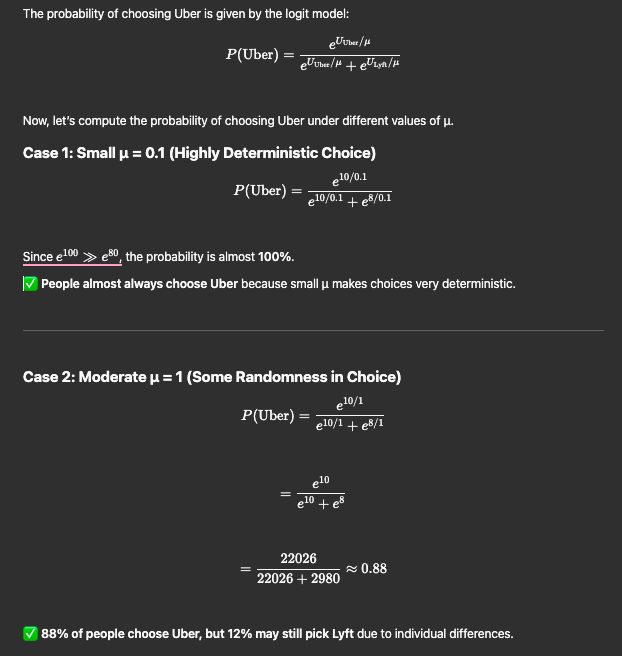
Since Uber has a higher utility (10) compared to Lyft (8), the customer is more likely to choose Uber. However, real-world decisions involve uncertainty, and that’s where the scale parameter μ plays a role.
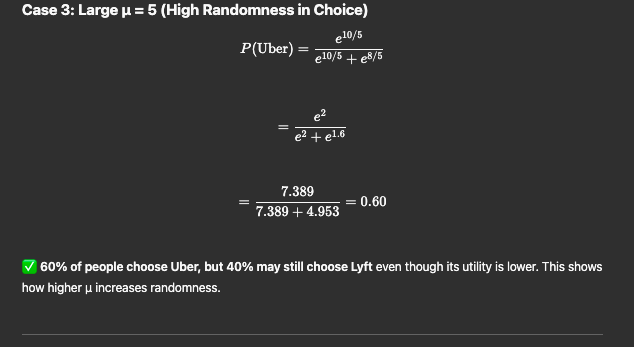
Step 3: Calculating Choice Probabilities with Different μ Values
Step 4: Key Takeaways
μ Value
Effect on Decision
Interpretation
Small (μ = 0.1)
Rational, utility-based choices
People always pick Uber because utility differences dominate
Moderate (μ = 1)
Some randomness
Most choose Uber, but a few may still prefer Lyft
Large (μ = 5)
Highly random choices
People may pick Lyft even when its utility is lower
Final Thought: The scale parameter μ controls how much “human randomness” is involved in decisions—a small μ means purely logical choices, while a large μ allows for unpredictable consumer behavior. Marketers and businesses can adjust their models to reflect real-world behavior more accurately.
A higher probability means the person is more likely to choose that option. If two options have similar probabilities (e.g., 55% vs. 45%), the choice is not strongly determined. If one option has 90% probability, it is the dominant choice.